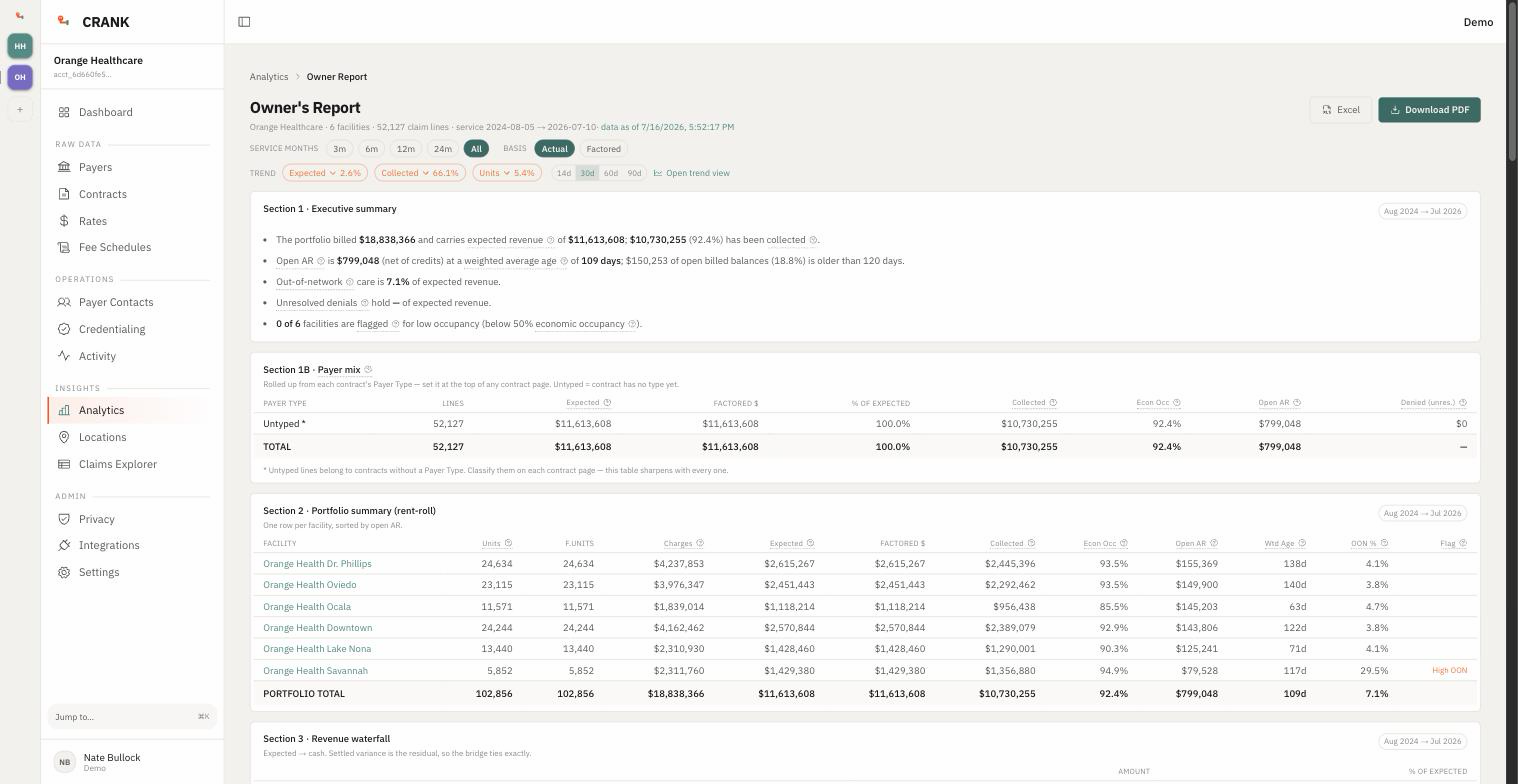
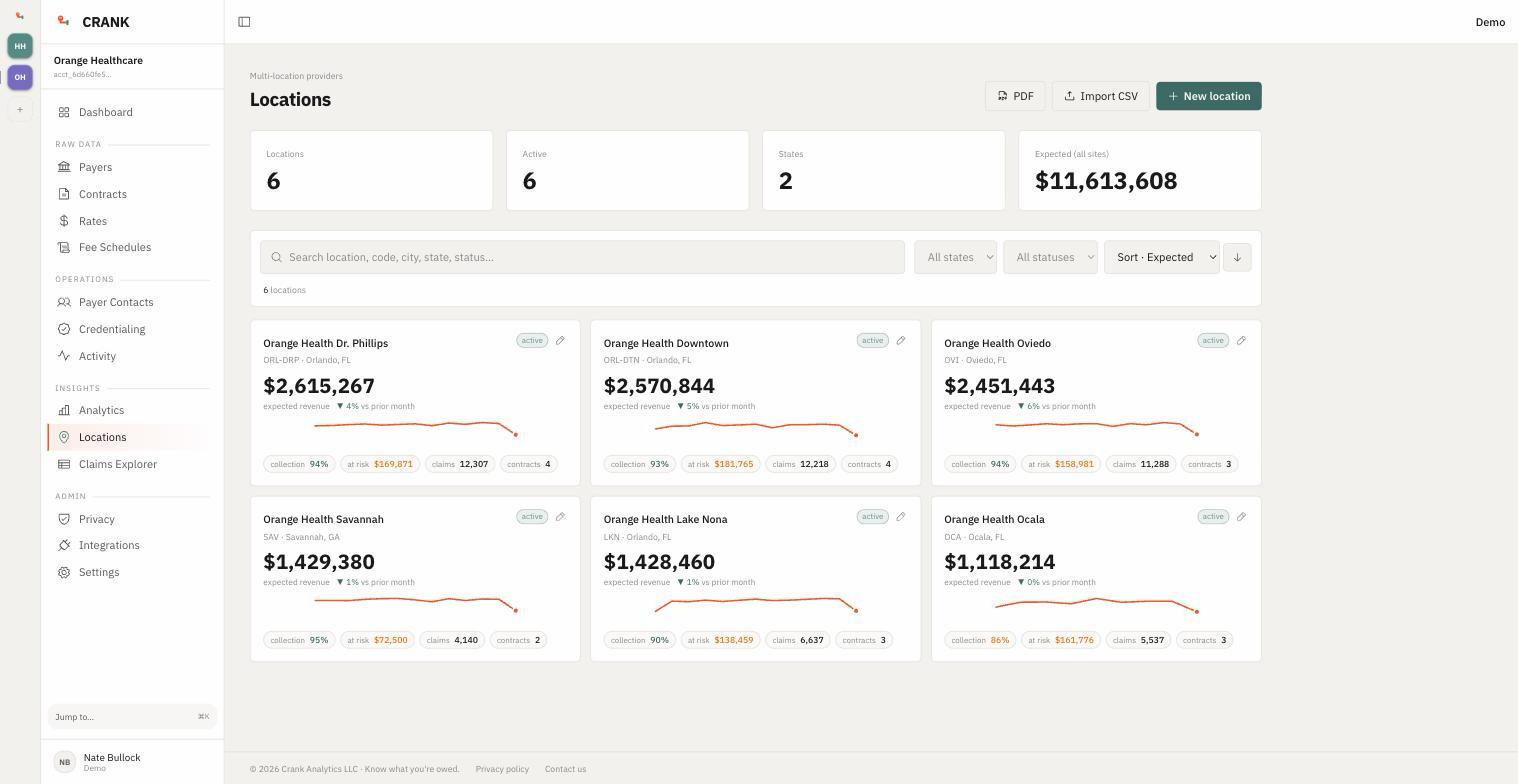
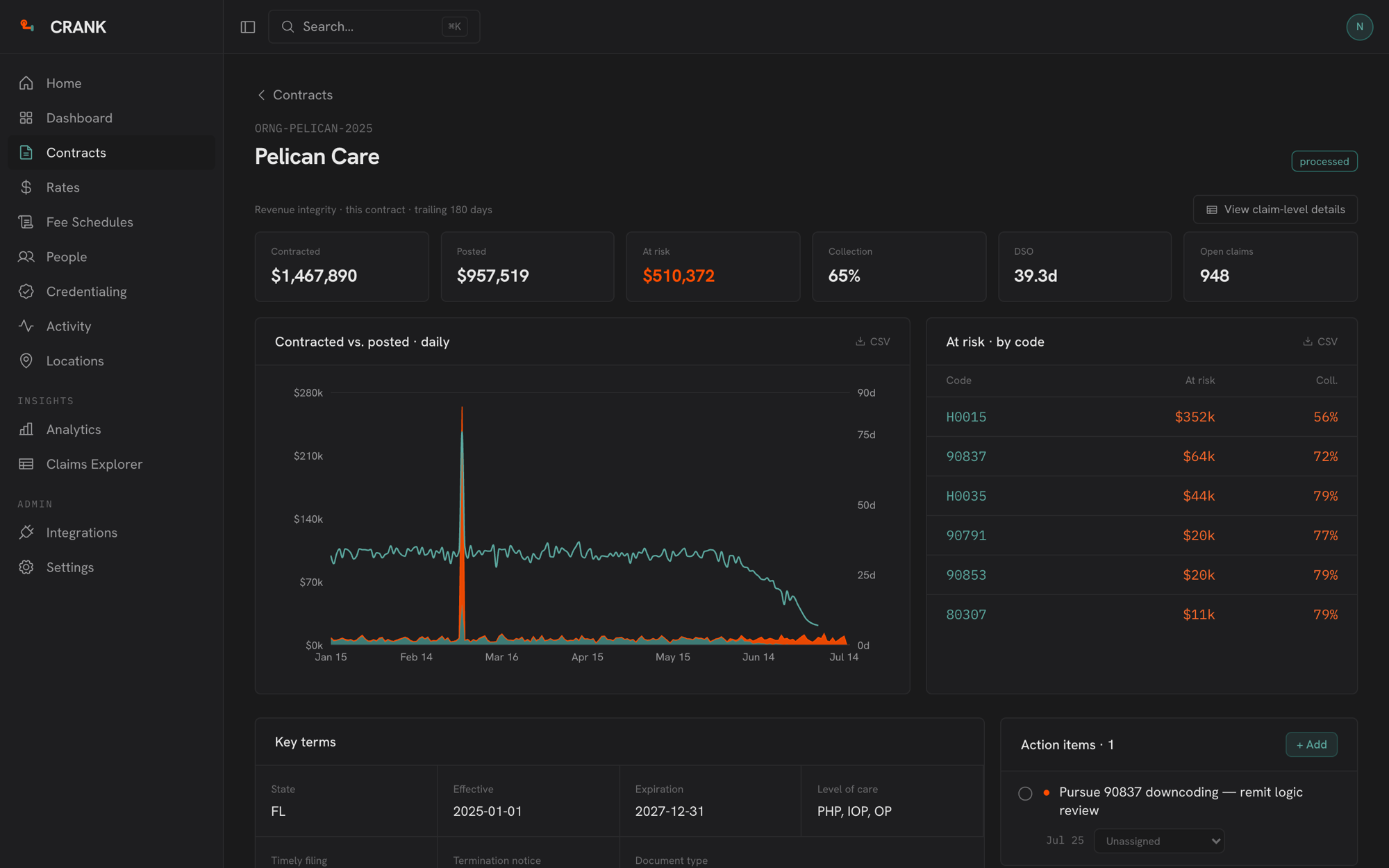
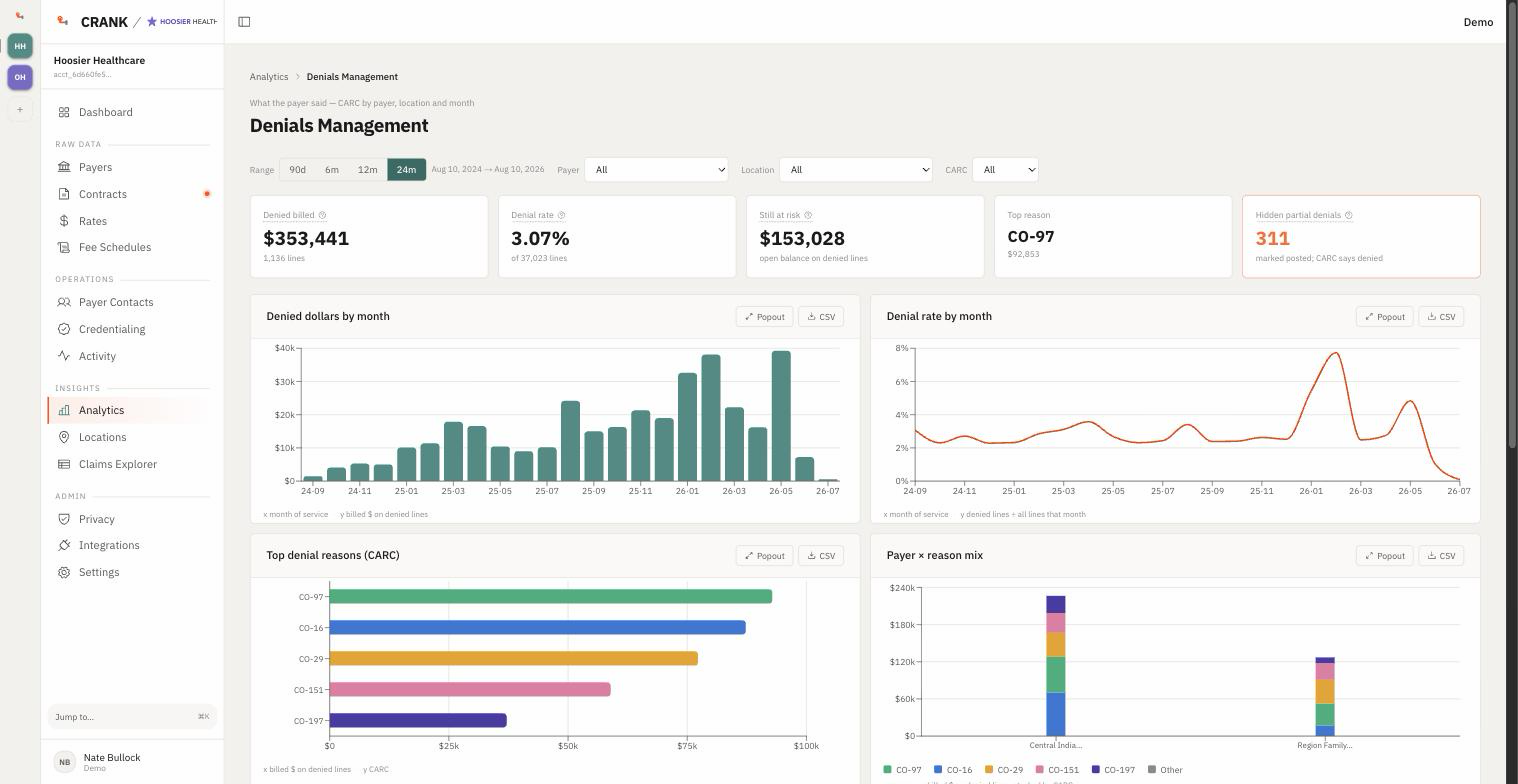
Payer requirements change faster than any billing team can track, and claims are now denied by machines in seconds. CRANK reads every contract you've signed, reconciles it against every payment — down to the CPT code — and shows you exactly where the money is leaking. No patient data.
Every figure below is from a primary source — government investigations, national surveys, CMS data. Click any of them. This is what your revenue cycle is up against now.
Amendments cut filing windows. Fee schedules re-issue. Auth rules shift mid-contract. Every unread change becomes a denial code three months later — and 77% of providers say the pace is accelerating.
Payers now run algorithmic claim review at scale; a federal lawsuit alleges one major insurer's algorithm had a 90% error rate — sustained because almost no one appeals. The only symmetric response is machine-reading your own contracts.
Rates live in a PDF. Claims live in the EHR. The people who negotiated the deal aren't the people submitting the claims — and nobody reconciles the two, code by code. That gap is where the leak lives.
CRANK turns the dead PDFs in your contract folder into a living, reconciled layer over your entire revenue cycle.
Drop in a contract — however ugly the payer's lawyers made it. Specialist extraction pulls every rate, rule, code, and date: 88+ structured data points, human-verified.
We connect to your billing system or EHR — carrying zero patient data — and compare what each contract says you're owed against what actually posted, claim by claim.
Every rate links back to the page and clause it came from. Every gap gets a dollar figure, a code, and a location. Nothing in CRANK is a black box.
An interactive walk through exactly how CRANK reads a payer contract, catches the leak, and puts a dollar figure on it. Enter three numbers about your operation and watch the math run on them — live, in front of you. No slideware, no sales call to get in.
Start the experience →CRANK ships a hosted MCP server — the open standard for connecting AI assistants to live systems. Connect it once and your reconciled contracts, claims, and payer scorecards are answerable from Claude, ChatGPT, or any MCP-capable assistant your team already uses.
In the app: Integrations → MCP access. Your admin grants it; the key is scoped, read-only, and shown once.
Add mcp.runcrank.com to Claude, ChatGPT, or any MCP-capable client. One URL, one key — no IT project.
Every answer is computed live from your reconciled data — the same numbers, citations and all, that the app shows.
Why it matters: when the board asks "where are we with Pelican?" at 4:55 on a Friday, the answer takes one question — not a week of analyst queue. Read-only by design, keyed per user, and — like everything in CRANK — carrying zero patient data.
None of these are the flat denials you'd notice. They're the quiet ones — the kind that surface a year later as a seven-figure surprise. Each scenario below is running live in our demo environment.
A payer starts paying your IOP code $212.50 against a contracted $250. Remittances still say "paid," so nobody flags it. CRANK flags the first week the paid rate stops matching the contract — before it's 1,400 claims deep.
A third of your 60-minute psychotherapy sessions (90837) quietly pay at the 45-minute rate (90834). Each claim looks plausible; the pattern is invisible in monthly totals. CRANK sees it per code, per payer, per week — the pattern has nowhere to hide.
A payer misconfigures a rate upward and overpays for months. You book it as revenue and spend it — then one recoupment letter claws back the total. CRANK flags overpayments as take-back risk the week they start: reserved, not booked.
A new location opens without the auth workflow. Within weeks it's generating CO-197 denials at half its volume — and the roll-up hides which site is bleeding. CRANK breaks denials out by reason and location, so the fix is retraining one team, not writing off a quarter.
An amendment cuts your filing window from 180 days to 90. The clause slips by. Clean claims start dying as "untimely" — and untimely denials don't appeal. CRANK reads the amendment and alerts you the day it lands.
Your best negotiator leaves, and two years of payer history, side agreements, and hard-won concessions leave with them. CRANK keeps every rate, note, and dated conversation mapped to the contract — for good.
CRANK never touches PHI or PII — by design. The data feed carries only contracts, codes, amounts, and dates, which kills an entire category of risk and means no Business Associate Agreement to negotiate. And your data is never held hostage.
Public and simple — priced per payer, and every plan is the entire product. A payer is one payer organization in one state (Aetna in five states = five payers — exactly how RCM billing already works). Unlimited contracts, documents, and fee schedules under every payer.
Rates step down like tax brackets — each rate applies only to the payers in that bracket, so adding a payer never reprices the ones before it. Pay annually and save 10% · commit multi-year and save another 5%.
Every plan includes MCP + API access and 30 staff users (additional users $240/user/year). Clinical leaders are free, always — location-scoped logins that see their own facility’s RCM data, so your site leaders work the numbers with you. EHR and billing-system integrations are never charged. Need a dedicated database? We offer it as a custom-scoped add-on. Book a quick call →
CRANK is payer contract intelligence for healthcare providers. It reads every payer contract you’ve signed, reconciles each one against what you were actually paid — down to the CPT code — and shows you exactly where revenue is leaking.
No. CRANK never ingests PHI or PII. It works only with contracts, codes, dates, and billed and paid amounts, so no Business Associate Agreement is required.
Yes. CRANK ships a hosted MCP server at mcp.runcrank.com. Mint a read-only key in the app, connect it to any MCP-capable assistant, and ask questions of your reconciled contract and claims data in plain English.
Your EHR and billing system run day-to-day operations. CRANK owns the missing contract layer — what each payer actually agreed to pay — flags every under- and over-payment, and feeds that intelligence back into your stack.
Public pricing is per payer — one payer organization in one state — with unlimited contracts, documents, and fee schedules under every payer. Rates step down like tax brackets: $995 per payer per month for your first 10 payers, $795 for the next 20 (11–30), $595 for the next 70 (31–100), and $395 beyond 100. Every plan includes MCP + API access and 30 staff users ($240 per user per year after that); clinical leaders are always free with location-scoped access. Pay annually for 10% off, or commit multi-year for another 5%. Implementation is custom-scoped and starts at $5,000, including hands-on training, human-verified contract ingestion, and EHR connection — with no patient data ever in the feed.
CRANK connects cleanly with modern EHR and billing platforms like Sunwave, Lightning Step, and Kipu, and works with most others through a simple, no-PHI data feed. It also offers a public API, an MCP server, and one-click export.
Most teams go live within about a week: a short kickoff call, then a single on-site Implementation Day where we ingest your contracts together and connect your data feed.
Every number links to its source — government investigations, CMS data via KFF, and national provider surveys from Experian Health, Premier, the AMA, and RTI International. We cite because that’s the product: numbers with receipts.
Tell us a little about your operation and we'll set up a working session — we read your contracts side by side and show you the gaps live. No slideware.
Know what you're owed.
Got it — we'll be in touch shortly.
Know what you're owed.