Payer contract intelligence · for healthcare providers

Know what
you're owed.

CRANK reads every payer contract you've signed, reconciles it against every payment down to the code, and shows you where the money is leaking. It carries zero patient data.

Book a Working Session → See what you get
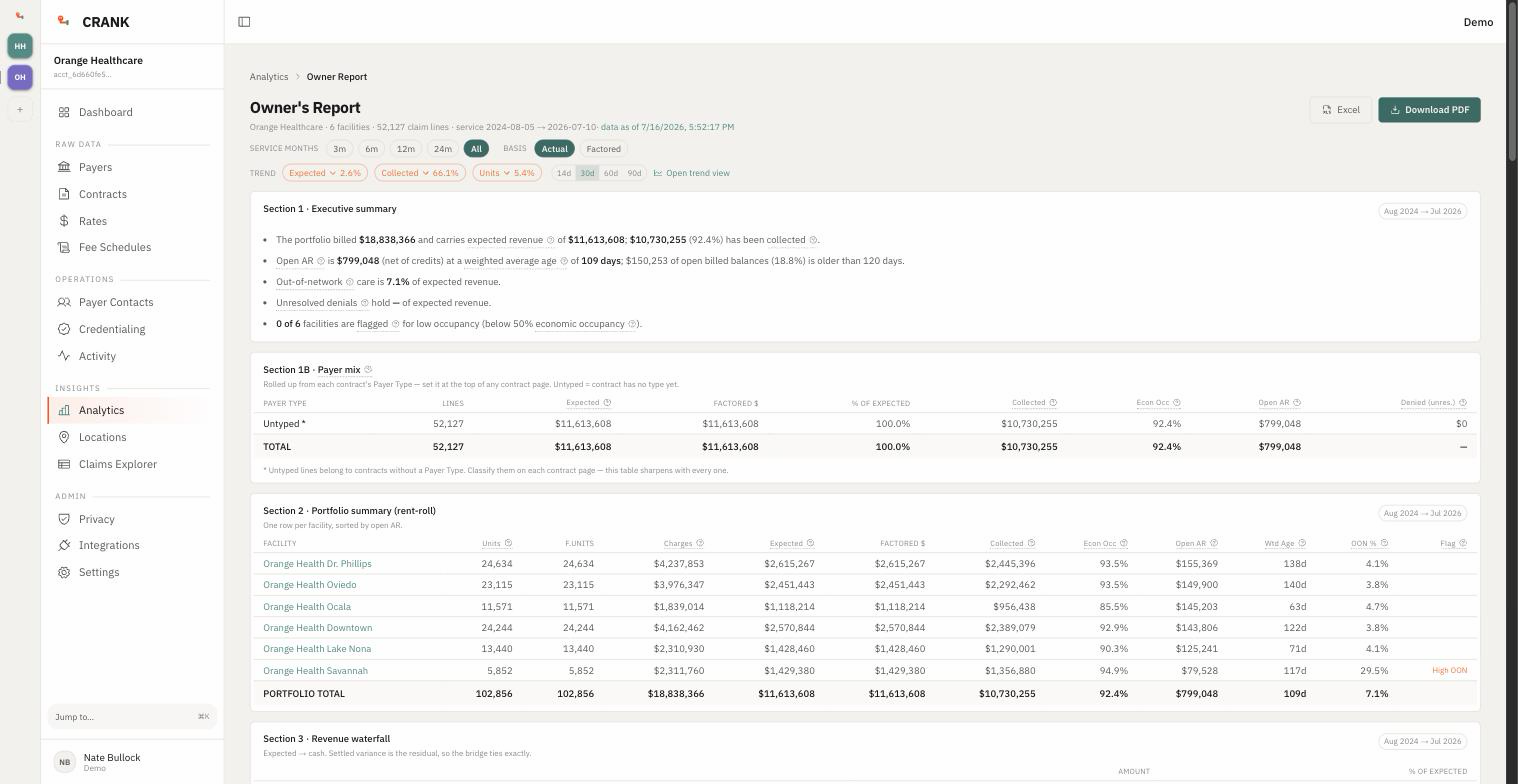
app.runcrank.com/analytics/owner-reportdemo data
CRANK Owner's Report: executive summary, payer mix, per-facility rent-roll with collection rate, open AR, and flags
The Owner's Report. Contracted, posted, at risk, and collection rate for the whole book and every facility under it. Current daily. Built from the contracts, not from whoever is billing this quarter.
Where CRANK comes from

Four questions. Four seconds each. They took weeks.

CRANK's founders carried a provider's contract analytics through a federal Chapter 11. Four billing partners cycled through. In court, every diligence expert asked the same four things.

01

Show me your payer contracts.

They were in SharePoint, in email, in a binder. Several had amendments nobody had filed.

02

Show me what you're supposed to be paid.

Rates lived in a spreadsheet three managers old. Nobody could say which version the EHR was using.

03

Show me what they currently owe you.

Each partner's number was different. Each was defended. None could be traced to a contract page.

04

Show me your volume.

Available. Eventually. In four formats that didn't agree with each other.

Your payer contracts are the record of what you're owed. CRANK is the tool that should have existed to read them.

The trust problem

Who runs your RCM? Whoever it is owns your version of the truth.

An RCM manager. A billing company. A consultancy. Everything you know about your own revenue is whatever they're telling you this quarter.

The handoff

The partner changes. The manager leaves. The reports, the definitions, and the history walk out with them.

Their numbers

Every partner arrives with their own reports. None of it matches your system, and you can't see how they got there.

The incentive

You pay a percentage of collections and hope that buys maximized collections. You have no independent way to check.

The guessing

"That dip? That's the transition quarter." Your trend line is an alibi, not an answer.

Whoever runs your revenue cycle, CRANK is the report card.

One standard dataset across every payer and every claim, built from the contracts you signed, held in your name through every vendor change. CRANK will never be your biller, which is exactly why it can grade whoever is.

What you see

The answers an owner asks for, without the analyst queue.

Every view below is live in the product on demo data. Every number in it traces to a contract page and a claim line.

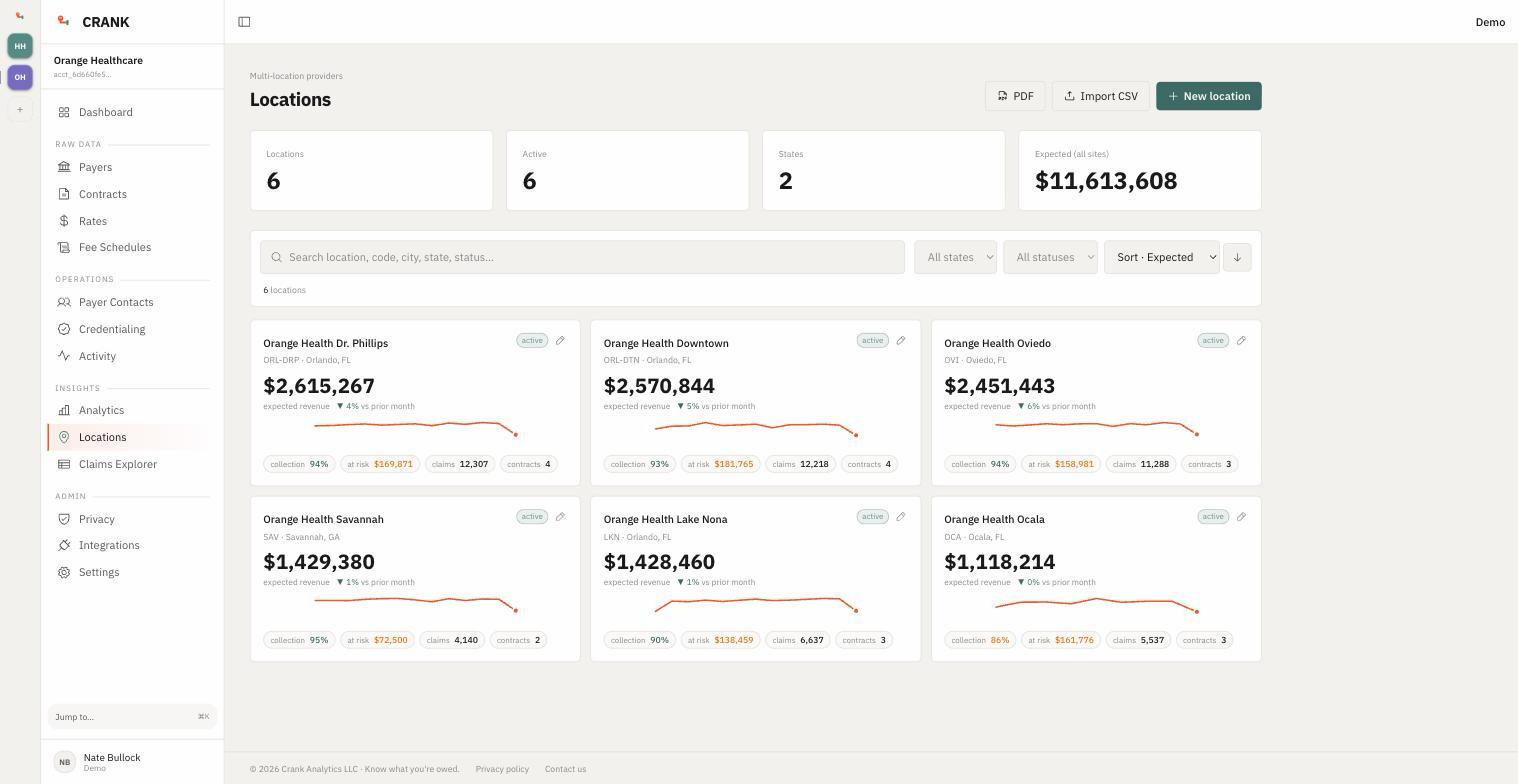
app.runcrank.com/locationsdemo data
Locations in CRANK: every site with its own contracted revenue, collection rate, at-risk balance, and claim count
Every location on its own scorecard. Clinical leaders log in free and land on their own site's numbers. The exec sees the book. A struggling site can't hide in a healthy average.
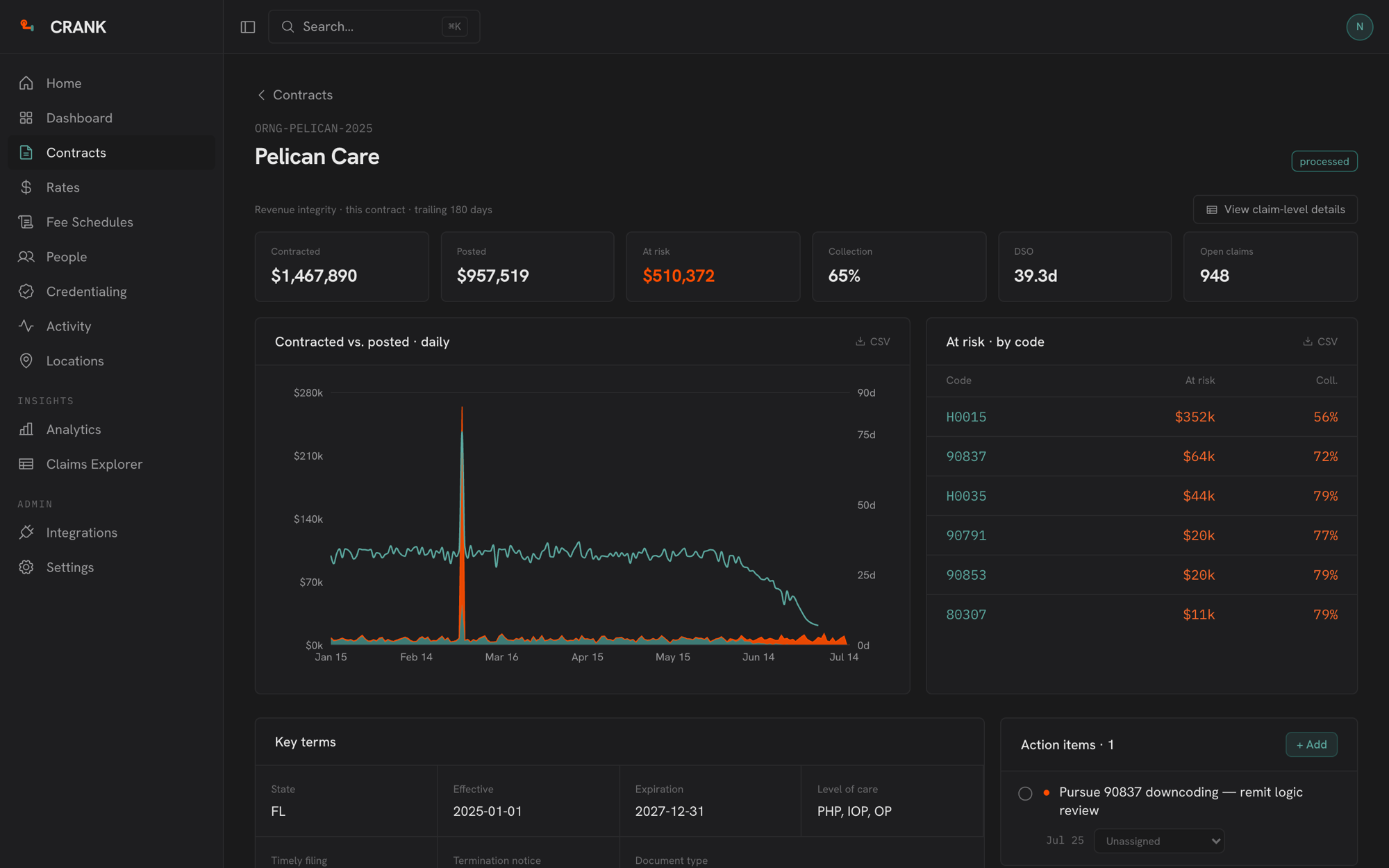
app.runcrank.com/contracts/ORNG-PELICAN-2025demo data
A single payer contract in CRANK: contracted vs posted and at-risk dollars by code, with every extracted term cited to its page
Any code, any contract, in one lookup. What this payer agreed to pay for this code, what they actually paid, and the page it came from. A contract review is minutes at a screen, not an afternoon with a PDF.
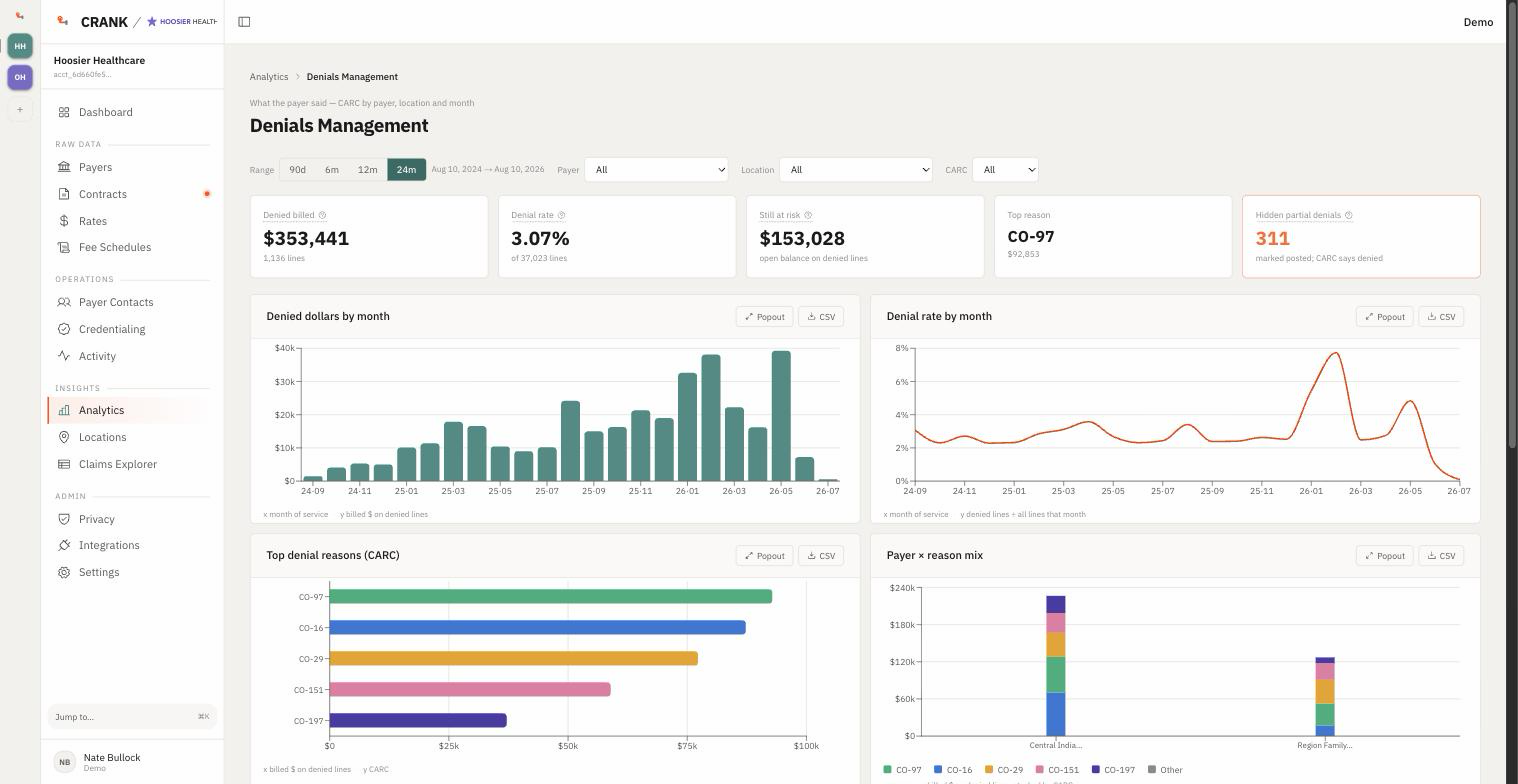
app.runcrank.com/analytics/denialsdemo data
Denials in CRANK: denied dollars and denial rate trending by month, top reasons by CARC code, payer-by-reason breakdown
Denials by month, reason, payer, and site. A cluster at one location on one code shows up the week it starts, not in the quarter's write-offs.
Your AI assistantconnected · crank mcp
Which payer owes us the most right now?
Pelican Care — the largest at-risk balance in the book, on ORNG-PELICAN-2025.

• Most of it sits on one IOP code (H0015): the paid rate has been running below the contracted rate since January.
• Collection on this contract is well below your book average.
• DSO is elevated vs. the portfolio.


Cited to Exhibit A, p.4 of the contract. Want the dispute summary drafted?
▸ contract_scorecard ▸ cpt_breakdown
Ask it in your own AI. Connect CRANK's MCP server to Claude, ChatGPT, or whatever your team already uses. The Friday-4:55 board question takes one question. Read-only, keyed per user, zero patient data.
How it works

Upload the contract. Get the truth back.

Four steps. Nothing in CRANK is a black box, and a number without a citation is broken by definition.

01 · EXTRACT

Read every contract

Every rate, rule, code, and date pulled from the PDF, however the payer's lawyers left it. Human-verified.

02 · RECONCILE

Match paper to payments

A no-PHI feed from your EHR or billing system. Each claim line priced against its contracted rate.

03 · EXPOSE

Every number, cited

Every gap gets a dollar figure, a code, a location, and the page it traces to.

04 · NEGOTIATE

Walk in armed

One click builds the strategy brief: rate gaps, dated payer communications, recoverable dollars.

Want the machinery? Watch the five-minute walkthrough →

Built right

Zero patient data. No BAA. Yours to take.

CRANK never touches PHI or PII. The feed carries contracts, codes, amounts, and dates, which removes an entire category of risk and means no Business Associate Agreement to negotiate. Your data is never held hostage: public API, MCP, one-click export.

Zero PHI / PII No BAA required Public API MCP server Per-user keys Location-scoped logins One-click export If you want to leave, take it
After you sign

Live in 30 days. One day on-site. No consultants.

CRANK's architects spent their careers implementing software at companies like Salesforce and SAP. Yours is fast because theirs were. No discovery phase, no integration project.

Step 130 min

Kickoff, remote. Nothing to prepare.

Step 21 day

Implementation Day, on-site. Your contracts read together. You see evidence on your own rates before we leave.

Step 330 min

Feed session with your EHR or IT owner. Live within a week.

Step 4~90 min

Training. Most teams need less, because Implementation Day was the training.

Pricing is per payer — one payer organization in one state, unlimited contracts under each — and every engagement is scoped on the first call.
FAQ

FAQs

What is CRANK?

Payer contract intelligence for healthcare providers. It reads every payer contract you’ve signed, reconciles each one against what you were actually paid, down to the code, and shows you where revenue is leaking.

Does CRANK use patient data or require a BAA?

No. CRANK never ingests PHI or PII. It works only with contracts, codes, dates, and billed and paid amounts, so no Business Associate Agreement is required.

Is CRANK a billing company?

No, and it never will be; the SOW says so. CRANK is the independent record of what you were owed and what was paid, whoever does the billing.

How is CRANK different from our EHR or billing system?

Your EHR and billing system run day-to-day operations. CRANK owns the contract layer: what each payer actually agreed to pay, graded against every posting.

How much does CRANK cost?

Priced per payer — one payer organization in one state — with unlimited contracts under each. Every engagement is scoped on the first call.

Which systems does CRANK connect to?

Sunwave, Lightning Step, and Kipu directly, and most others through a simple no-PHI claims feed. Public API, MCP server, and one-click export included.

How long does implementation take?

Typically fully live within 30 days: a 30-minute kickoff, one on-site Implementation Day, a 30-minute feed session with your EHR owner, and training. No discovery phase, no consultants.

Can I query CRANK from Claude or ChatGPT?

Yes. Mint a read-only key in the app, connect mcp.runcrank.com to any MCP-capable assistant, and ask in plain English. Same numbers as the app, citations included.
See it on your contracts

Bring us a payer contract. We'll read it.

Tell us a little about your operation. We set up a working session, read one of your contracts alongside you, and put a dollar figure on what it turns up. Live, on your numbers.

Know what you're owed.

A payer is one payer org in one state — Aetna in 3 states = 3 payers.